Before You Hire Your First Employee, Get Your Shop's Foundation Right
There's a version of the trade business story that gets told a lot: talented craftsperson goes out on their own, hustles hard, builds a reputation, and eventually has more work than they can handle. Then they hire someone. Then another person. Then things start falling apart in ways that are hard to explain.
The work is good. The reputation is solid. But something isn't working.
Nine times out of ten, the problem isn't the people or even the market. It's the foundation—or the lack of one. The infrastructure decisions that get made (or ignored) in the early years of a trade business have a way of becoming the ceiling that limits everything that comes after.
This isn't about having the fanciest setup or spending money you don't have. It's about making the right calls at the right time so that your business can actually grow without breaking.
The Workspace Problem Nobody Talks About
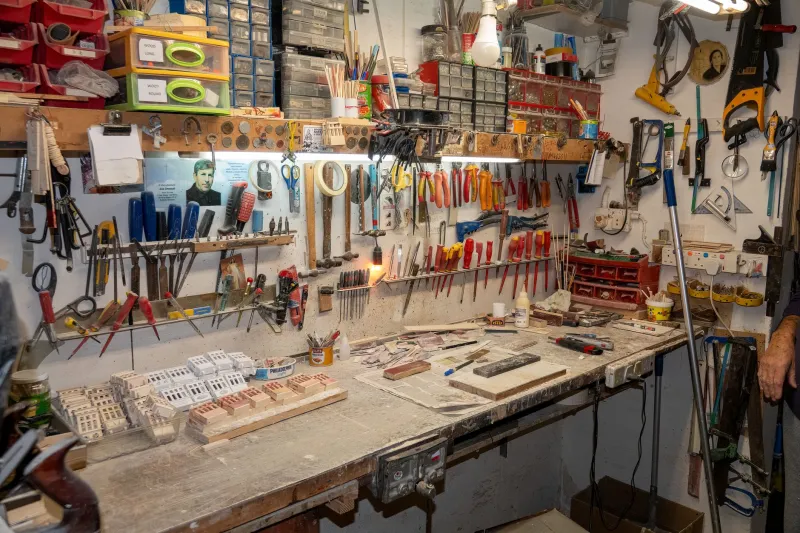
A lot of trade businesses start the same way: in a garage, a driveway, or a small rented bay that was available and affordable. That's fine. Most great shops started somewhere humble.
The problem comes when the workspace stops matching the business. A shop layout that works for one person doing $200K a year in revenue becomes a serious bottleneck when you're trying to run a two- or three-person crew and hit $600K. You can't just add bodies to a space that wasn't designed to support them.
The tradespeople who scale successfully tend to think about their workspace not just in terms of what they need right now, but what they'll need at the next stage. That doesn't mean over-investing in space you're not ready for—it means being deliberate about the transition point. When does the current setup stop working? What would the next setup need to look like? Having that answer ready before you hit the wall is the difference between a planned upgrade and a crisis.
For custom furniture maker Ray Tillman in Portland, Oregon, the move from a 600-square-foot garage to a leased 2,400-square-foot commercial space felt premature—until it wasn't. "I waited almost two years too long," he says. "I was turning down work because I had nowhere to put it. That lease scared me, but it forced the growth."
Tool Investment: The Math Most People Get Wrong
Here's a mindset that holds a lot of tradespeople back: thinking about tools as expenses rather than as infrastructure. The framing matters more than you'd think.
A $12,000 piece of equipment that cuts your production time by 30% and reduces rework isn't a cost—it's a multiplier. The challenge is that the ROI isn't always obvious in the moment, especially when cash flow is tight.
The trade businesses that scale well tend to be disciplined about two things: buying quality where it directly affects output, and not over-buying where it doesn't. A plumber who invests in a high-end pipe inspection camera is buying the ability to diagnose faster and bid more accurately. That's infrastructure. A plumber who buys a second van before the first one is consistently booked is buying overhead.
The question to ask before any significant tool or equipment purchase isn't "can I afford this?" but "does this remove a bottleneck in my business?" If the answer is yes and the math works over a reasonable timeframe, it's usually the right call.
Scheduling Systems: The Unsexy Thing That Saves You
If there's one area where small trade businesses consistently leave money on the table, it's scheduling. Not because they don't work hard—they do. But working hard without a reliable system for managing jobs, time, and follow-up is like running fast in the wrong direction.
The feast-or-famine cycle that plagues so many solo operators and small shops is often a scheduling problem in disguise. When you're slammed, you stop marketing and booking future work. When the current jobs dry up, there's nothing in the pipeline. Repeat forever.
A simple job management system—even a well-maintained spreadsheet before you graduate to software—can break that cycle by giving you visibility into what's coming. Knowing that you have three weeks of work confirmed and nothing after that is actionable information. Flying blind until the last job wraps up is how you end up scrambling.
Software like Jobber, ServiceTitan, or even simpler tools like Google Calendar with a consistent booking process can make a real difference. The specific tool matters less than the discipline to actually use it.
"I used to run everything in my head," admits HVAC contractor Pauline Reyes in San Antonio. "When it was just me, that worked fine. The second I added a tech, I started dropping balls. We moved to a basic dispatch system and within two months I could actually see where the holes were."
Quality Control as a Scalability Tool
This one surprises people: quality control isn't just about making sure the work is good. It's a scalability mechanism.
When you're the only one doing the work, quality is self-regulating. You see everything. You catch your own mistakes. But the moment you add people, that self-regulation disappears. Your name is still on the work, but your eyes aren't on every detail.
The shops that grow without their reputation taking a hit tend to have built quality checkpoints into their process before they needed them. That might look like a job completion checklist, a photo documentation habit, or a structured walkthrough with the customer before the invoice goes out. It doesn't have to be complicated—it just has to be consistent.
Building these habits when you're small means they're already part of the culture by the time you're managing multiple crews. Trying to retrofit quality control onto a growing operation is a lot harder than building it in from the start.
Infrastructure Is the Work Behind the Work
The craftspeople who build lasting businesses understand something that the ones who stay stuck often miss: the business itself is something you have to build with the same care and intentionality as the work you do for customers.
Your workspace, your tools, your systems, your quality processes—these aren't administrative annoyances. They're the infrastructure that either lets your business grow or quietly prevents it from ever getting off the ground.
Get that foundation right, and everything else gets easier.