Why the Materials You Choose Say More About Your Business Than Your Portfolio Does

Photo by Photo by Alex Gruber on Unsplash on Unsplash
There's a conversation that happens on job sites all across the country, and it usually sounds something like this: the client asks if you can knock a few hundred bucks off the quote, and the easiest place to find that savings is the materials line. Swap the better stuff for something cheaper, pocket the margin, move on.
It's tempting. And in the short run, it works. In the long run, it's one of the quietest ways a trade business erodes its own reputation.
The craftspeople who've built genuinely durable businesses — the ones with waitlists and referrals and clients who don't flinch at their rates — tend to share one thing in common. They're deeply intentional about what they put into their work. Not just because it produces better results, but because materials are a story they get to tell.
The Difference Between Cheap, Expensive, and Smart
Let's clear something up right away. Being selective about materials doesn't mean always buying the most expensive option. It means understanding the value chain — what a material actually delivers over time, how it performs under real conditions, and what it signals to your client.
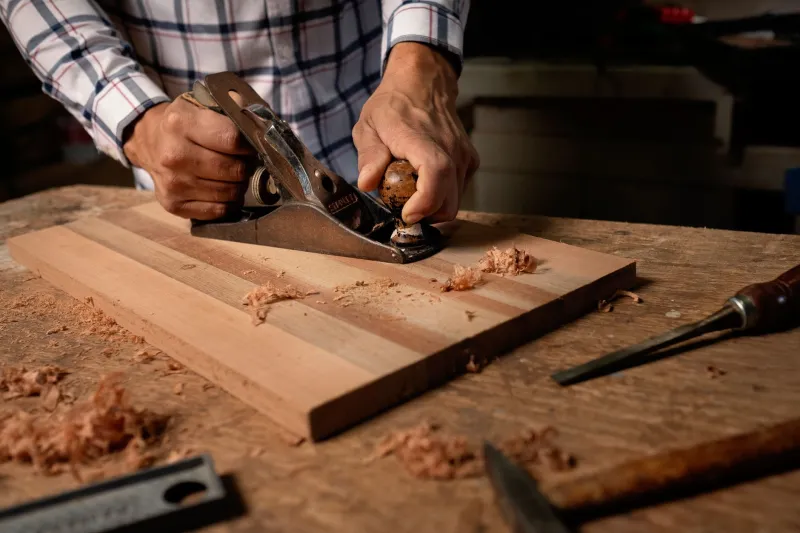
There's a reason experienced finish carpenters can walk into a lumber yard and immediately start sorting through a stack of boards. They're not just looking for straight grain. They're evaluating moisture content, knot placement, and how each piece will behave once it's in a heated home. That knowledge — the ability to select well — is a skill that took years to develop, and it shows up in the finished work.
The same logic applies across trades. A plumber who specs out fittings based on the specific water chemistry in a region isn't being fussy. They're preventing callbacks. An electrician who chooses a specific wire gauge for a commercial kitchen isn't gold-plating the job. They're accounting for real load conditions. A mason who insists on a particular mortar mix for a freeze-thaw climate isn't upselling. They're doing the job correctly.
Being smart about materials means being able to explain the why — and that explanation is often the difference between a client who questions your price and one who defends it to their neighbor.
Supplier Relationships Are Underrated Business Assets
Most tradespeople think of their suppliers as vendors. The best tradespeople think of them as partners.
When you build a real relationship with a supplier — consistent volume, prompt payment, honest communication — you gain access to things that don't show up on a price sheet. Early notice on product changes. Priority during supply crunches (and anyone who worked through 2020 to 2022 knows how real those can get). The ability to call someone who actually knows the product line and can help you solve a field problem.
Beyond logistics, supplier relationships give you credibility with clients. Being able to say "I work exclusively with [specific regional supplier] for my hardwood because of how they handle their kiln-drying process" isn't just name-dropping. It's demonstrating that you've thought through your supply chain. Clients who care about quality notice that.
If you're currently buying materials wherever the price is lowest that week, consider what you might be leaving on the table. A slightly higher per-unit cost from a trusted supplier often pays for itself in consistency, fewer defects, and the kind of relationship that bails you out when something goes sideways on a job.
Making Your Material Choices Part of Your Sales Process
Here's where a lot of skilled tradespeople leave real money behind. They make thoughtful, well-researched decisions about materials — and then never mention it to the client.
Your material selections are a selling point. They belong in your proposal, your client conversations, and even your social media if you're using it. Not in a boastful way — in an educational way. Clients who understand why you chose a specific product are far less likely to ask you to swap it for something cheaper. They've been brought into the decision.
Consider how this plays out in practice. A flooring contractor in the Pacific Northwest who explains to clients that they use a specific engineered hardwood line because of its dimensional stability in high-humidity environments isn't just talking specs. They're demonstrating expertise. They're building trust. And they're quietly justifying a price point that a competitor who just "installs hardwood" can't match.
The same principle works in roofing, HVAC, concrete work, cabinetry — any trade where the client has some choice in what goes into the job. Walk them through your thinking. Most clients don't know what they don't know, and the tradesperson who teaches them something becomes the one they remember.
Building a Reputation That Outlasts Any Single Job
Material quality has a long tail. A deck built with properly dried, treated lumber that still looks great after 15 years doesn't just make a homeowner happy. It makes them a walking advertisement. It shows up in the neighborhood, at the block party, in the "who did your deck?" conversation.
Conversely, a job that fails early — because corners were cut on materials — has the same long tail, just in the other direction. In the trades, reputation is compounding interest. The choices you make on today's job are still paying dividends (or bills) five years from now.
Being selective about materials is one of the most straightforward ways to load that compounding in your favor. It costs more upfront, requires more knowledge, and demands more from your supplier relationships. But it builds the kind of craft legacy that this industry is actually built on.